
An Evening with Elizabeth Gilbert London, 2026


I'm not a fanatic at all… I even designed my own T-shirt for the event. 😊
On Monday evening, 2 March 2026, I had the privilege of attending An Evening with Elizabeth Gilbert: All the Way to the River at London's Barbican. The event consisted of a talk followed by a Q&A session, during which Elizabeth shared the story behind her new memoir, how it came to life, and the painful lessons that shaped it.
What did this evening mean to me?
It is difficult to put into words what it felt like to sit just a few metres away from Elizabeth Gilbert. What happens when one of your greatest inspirations is no longer speaking to you through the pages of a book, a podcast, or from a distant stage, but is standing right in front of you as a real person, revealing just how much heartbreak, self-abandonment, addiction, and shame can exist beneath what appears to be a successful life?
Liz was captivating. To me, she is an extraordinary woman living an extraordinary life, and she shares it with remarkable honesty. She is powerful yet humble, light-hearted yet profound, funny yet deeply moving. I wasn't simply looking at a world-famous author. I was looking at the person whose words, years ago, gave me the courage to believe more seriously in creativity, and in myself.
As I looked around the packed auditorium, I was struck by a strange feeling. We had all come there for different reasons, I'm sure. Yet there was a shared sense of curiosity, openness, and searching that connected us. Elizabeth Gilbert has always been far more than a successful writer to me.
Eat, Pray, Love introduced me to her world. I first watched the film, starring one of my favourite actresses, Julia Roberts. Later I read the book, which, unsurprisingly, was almost impossible to put down. Then came Big Magic, a book that left a lasting impression on me.
Since then, I have followed Elizabeth's work through podcasts, interviews, essays, and her Substack newsletter whenever I can.
If I had to sum up what she has given me in one sentence, it would be this:
The courage to begin, and permission to create.
Permission to understand that I don't have to be a literature professor. I don't have to be perfectly prepared, and I don't need to know every writing rule before I begin. I simply need to pay attention to what is trying to take shape inside me, and be brave enough to give it words.
Alongside Rick Rubin and several other creators I mention in Dreamers & Seekers, Elizabeth Gilbert has been one of the greatest inspirations on the journey that eventually led me to writing my own book.
What does it feel like to realise that the books which once set you on your own path have now become part of the story behind your own? And what does it feel like to walk into one of the biggest bookshops in your home country and find your own book sitting just a few shelves away from Elizabeth Gilbert's?
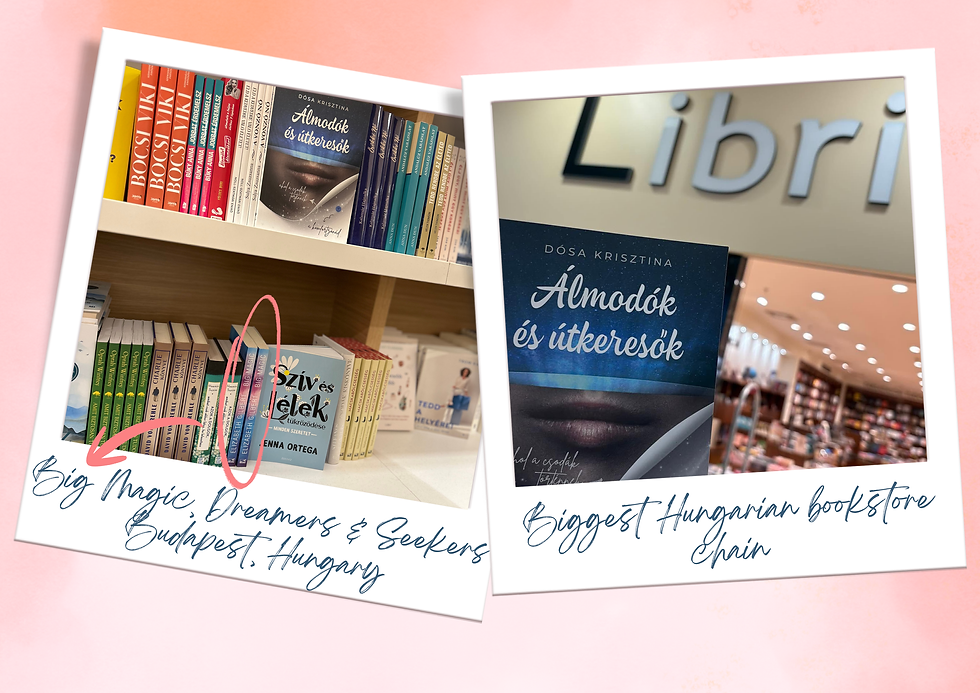
There is another thread I would only like to touch on briefly in this post.
Dreamers & Seekers owes a great deal to Elizabeth Gilbert. She came into my life at a time when I needed someone to remind me that creativity requires, above all else, courage and perseverance.
I'll share more about that in a separate post soon. But for now, let's return to London...

Before the event began, Elizabeth ran across the stage, smiling, waving, and posing for a few moments. She encouraged everyone to take all the photos and videos they wanted while they had the chance.
Then she asked us to put our phones away and give one another our full attention.
I know it sounds almost unbelievable, but that's exactly what happened.
It was genuinely moving to see the audience respond to a single request. No glowing screens. No camera flashes. You could almost feel the energy in the room. We were simply present with one another, listening with open hearts.
The evening at the Barbican centred on Elizabeth's new memoir, All the Way to the River.
Even from the way she spoke about it, I could tell it would be an intensely personal and emotionally demanding book. Because of my own sensitivity, I want to give myself time before reading it. I'm quite certain it won't be an easy journey.
How do you create something meaningful from a life that is falling apart?
Throughout Elizabeth Gilbert's work, creativity has never been just a profession. It is a way of relating to life. A willingness to approach what we don't yet understand with curiosity, to hold our experiences in our hands, and slowly transform them into something meaningful.
In that sense, All the Way to the River is an act of creation in itself. Chaos is given structure. Shame is given language. Loss is shaped into something in which other people may recognise fragments of their own stories. In the book, Elizabeth explores her relationship with Rayya Elias, alongside grief, co-dependency, love and sex addiction, and the long journey of recovery. According to the official description of the event, she wanted to speak especially to those who feel restless, trapped by attachment, desire or addiction, and who are searching for a deeper meaning in their lives.
One of the most powerful themes of the evening was how easily we can abandon ourselves for the sake of a relationship. Elizabeth said more than once that this was the book she never wanted to write, yet ultimately felt she had to. Perhaps this is one of the greatest dilemmas of writing memoir. A story can be deeply personal while inevitably touching the lives of others. It can be healing while reopening old wounds. It can be truthful, even when telling that truth is neither comfortable nor flattering.
In several interviews surrounding the book, Elizabeth has spoken about the difference between a diary and a memoir. A diary captures life as we are living it, while a memoir requires distance, reflection, and time to understand what those experiences truly meant. She has also spoken about the responsibility memoir writers carry when telling stories that involve other people's lives.
At this point, I'd like to mention Anne Boyd Rioux—author, literary historian, and one of the people who also attended the Barbican event before writing a thoughtful reflection about it.
According to Anne's account, Elizabeth spoke about patterns that many women may recognise in their own lives:
putting other people's happiness before our own;
being afraid to set boundaries because we fear losing those we love;
believing we must earn love through self-sacrifice;
giving far more than we receive;
trying to fill the absence of love through addiction, work, achievement, or constant striving.

Laura—whom I had the pleasure of meeting during a Zoom session at a writers' retreat—is the Hungarian translator of three of Elizabeth Gilbert's books: Eat, Pray, Love, Big Magic, and The Signature of All Things. Laura met Liz in Amsterdam, while Anne had the opportunity to meet her in London.
Photo credits: Laura's and Anne's Substack pages (links embedded).
It became much more than a book launch
I felt exactly the same. This evening was far more than a traditional book launch. It became a shared moment of reflection. Anne had purchased a premium ticket, which gave her the opportunity to meet Elizabeth in person. In her account, she describes waiting for around thirty minutes before Liz welcomed her with open arms, hugged her, recognised her name, and even remembered one of her previous articles. Anne told her that Big Magic had helped her realise she wasn't living the life she truly wanted. Since then, she has left her academic career behind and is now working on her first novel.
Elizabeth's reply consisted of just two simple words:
"Keep going."
That story felt deeply familiar to me. My self-discovery book is now available in two languages, while my first novel is waiting to be completed. Anne's story resonates with mine in many ways. To me, Liz is someone who does far more than inspire other creators. Sometimes a single sentence, a recommendation, or simply the courage to share her own story honestly is enough to open doors we might never have dared to walk through ourselves.
Just write what happened
Another part of the evening that stayed with me was Elizabeth's advice about writing. She encouraged us to simply begin. When we get stuck, she said, we shouldn't search for the perfect sentence. We should start by writing down what we already know. She even suggested that memoir can be one of the most accessible places to begin, because you're starting with a story you already know: your own. Whether you're writing non-fiction or fiction inspired by your life, the important thing is simply to begin.
It can be as simple as:
"I enrolled at this school. I met someone there. This happened. This is how I felt. And this is what happened afterwards."
While writing that first draft, don't worry about making it beautiful, literary, or perfect. Let the story flow out first. There will be time later to shape it, polish it, and rewrite it. Those first thoughts, images, and emotions are unique. If we begin editing too soon, we risk losing the raw honesty that gives a story its life.
This resonated deeply with me because it's instinctively how I write as well. I experience stories first through emotions and images. The words arrive later. Whenever I get stuck in a scene or lose my way among my characters, I simply write down what I can already see. Where they are. What they're doing. What they're thinking. How the scene feels. The beautiful sentences can come later. First, the story simply needs to exist. There was something incredibly reassuring about hearing a writer I admire so deeply encourage other writers to give themselves that same freedom.
The Creator and the Editor
I think there's a fascinating psychological reason behind this. Whenever we write, we're constantly moving between two different roles. One is the Creator: curious, instinctive, playful, observant, and unafraid of making a mess. The Creator's job is simply to produce the raw material.
The other is the Editor. The Editor analyses, rewrites, shortens, questions, and searches for structure and clarity. We need them both. The problem begins when they try to work at the same time.
When the inner editor interrupts every sentence with thoughts like, "This isn't good enough. It's too simple. It's too long. Other people write so much better than you," the Creator slowly loses confidence. The flow disappears, curiosity gives way to anxiety, and writing becomes much harder than it needs to be.
I know that feeling only too well. Perfectionism has often paralysed me to the point where it feeds my impostor syndrome. For me, Big Magic became the antidote. It reminded me that creativity doesn't require perfection. It requires presence, curiosity, courage, and perseverance. One of Elizabeth's favourite sayings comes from her mother: "Done is better than good."
That evening reminded me once again that we first have to allow a story to come into existence. Its final shape can always come later.
When a Book Title Takes on a Life of Its Own
The evening took place almost exactly twenty years after the publication of Eat, Pray, Love. Coincidentally, it was also very close to my own fortieth birthday. (In fact, this ticket was my birthday present to myself.)
The book was first published in February 2006. It's hard to believe that two decades have already passed. Elizabeth smiled as she shared a story about how, over the years, the title had gradually taken on a life of its own. I may not remember every detail perfectly, but this is how the story stayed with me.
She spoke about a young woman who excitedly described her plans for her own "Eat Pray Love journey", or perhaps she was already living it. During their conversation, it became clear that she didn't know Eat, Pray, Love was originally the title of a book, or even who had written it.
Rather than feeling offended, Liz found the whole situation flattering and rather amusing. The spirit of the book had travelled so far that people were using its title without ever having read it or knowing who wrote it.
To me, that carries a much deeper meaning.
Eat, Pray, Love has become far more than the story of one woman's journey through Italy, India, and Indonesia. It has become a cultural expression, a shorthand for leaving behind the familiar, stepping into the unknown, and searching for yourself. People talk about going on an "Eat Pray Love journey". Retreats and travel experiences borrow its name. The phrase has become a symbol of self-discovery, new beginnings, and having the courage to start again.
Perhaps that's one of the greatest, and most unusual, successes an author can experience: when their work continues to live in people's lives long after many have forgotten where it first began.
My Own Journey
I set off on my own version of that journey in 2020. 2019 had been one of the most difficult years of my life. After making a sudden decision, I found myself in England just before the first news of Covid reached the world. Sometimes I don't even dare imagine what would have happened if I hadn't left. If the world had closed down while I was still trapped in the place that had become the source of so much pain, my story might have taken a very different path. Looking back now, I realise that leaving wasn't simply a journey to another country. It was the first step towards finding my way back to myself.
That one decision, rooted in real life, has since become the starting point of the self-discovery novel I'm writing, where a true turning point evolves into fiction. To me, this song beautifully captures the spirit of the book.
There was no perfectly planned adventure waiting for me. Just a suitcase, a great deal of uncertainty, and a quiet feeling that I needed somewhere to breathe again. So I signed up to spend a few months volunteering on what felt like a fairytale country estate, where even a treehouse was waiting for me.
And this is what I shared on Facebook just a few days before I left...
Sometimes we only understand years later what kind of story we stepped into.
And even if our boots become muddy along the way, at least we'll know we truly lived.

What Did I Take Home from the Evening?
It was liberating, encouraging, and, in the very best sense of the word, deeply moving to see the very human Elizabeth Gilbert. That evening, she wasn't standing before us as the endlessly uplifting, inspirational figure so many people know. She stood before us as someone willing to reveal the darkest, most painful, and least flattering chapters of her own life. She spoke about losing herself, recognising her own responsibility, and slowly finding her way back again.
Today, Elizabeth Gilbert does far more than write books. She creates a community built around curiosity, vulnerability, love, creativity, and honest conversations with ourselves.
For me, this evening was another reminder of just how far an honestly told story can travel. It can cross borders. It can reach another generation. It can find someone who is searching for the courage to begin.
And sometimes, a single sentence is enough to help us take the next step.
"Just keep going, I am here for you."
Comments